

By Matteo Giardino
If you want to run local voice cloning in 2026, Fish Audio S2 Pro is the open-source solution you need. Text-to-speech has always had one problem: it sounds flat. In most cases you can't tell if it's a machine or human. Fish Audio S2 Pro is trying to change that.
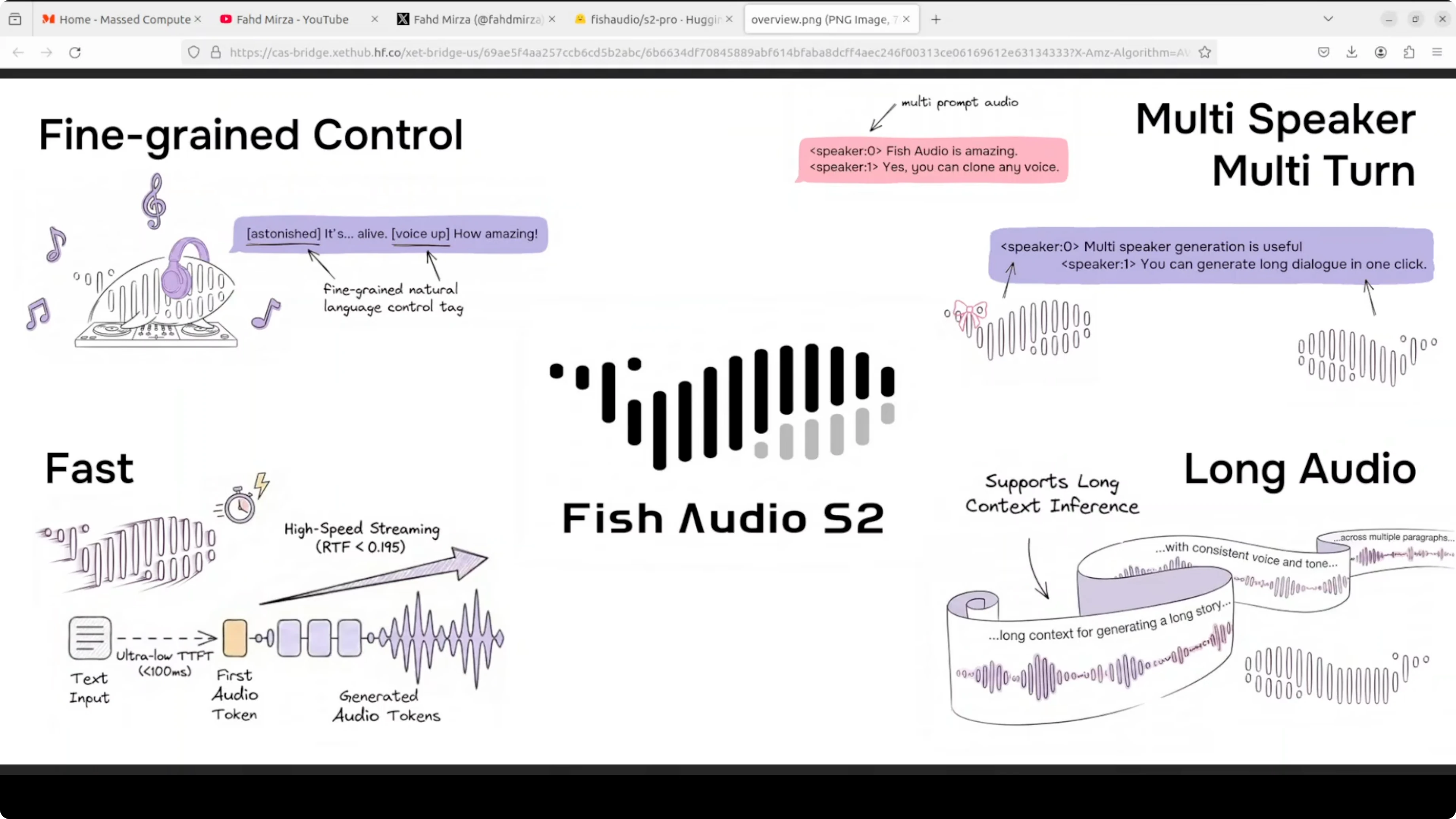
It's an open-weight TTS model you can run locally on your machine (perfect for building an offline AI voice assistant), trained on 10 million hours of audio across 80 languages. The key feature? You control exactly how the voice sounds by embedding tags directly in your text.
Write [whisper] and it whispers. Write [laugh] and it laughs. There are 15,000 supported tags - from laughing to professional broadcast tone to completely custom descriptions you can make up yourself.
Fish Audio S2 Pro - Technical Architecture
Under the hood, Fish Audio S2 Pro uses a dual model architecture. Two neural networks working in tandem:
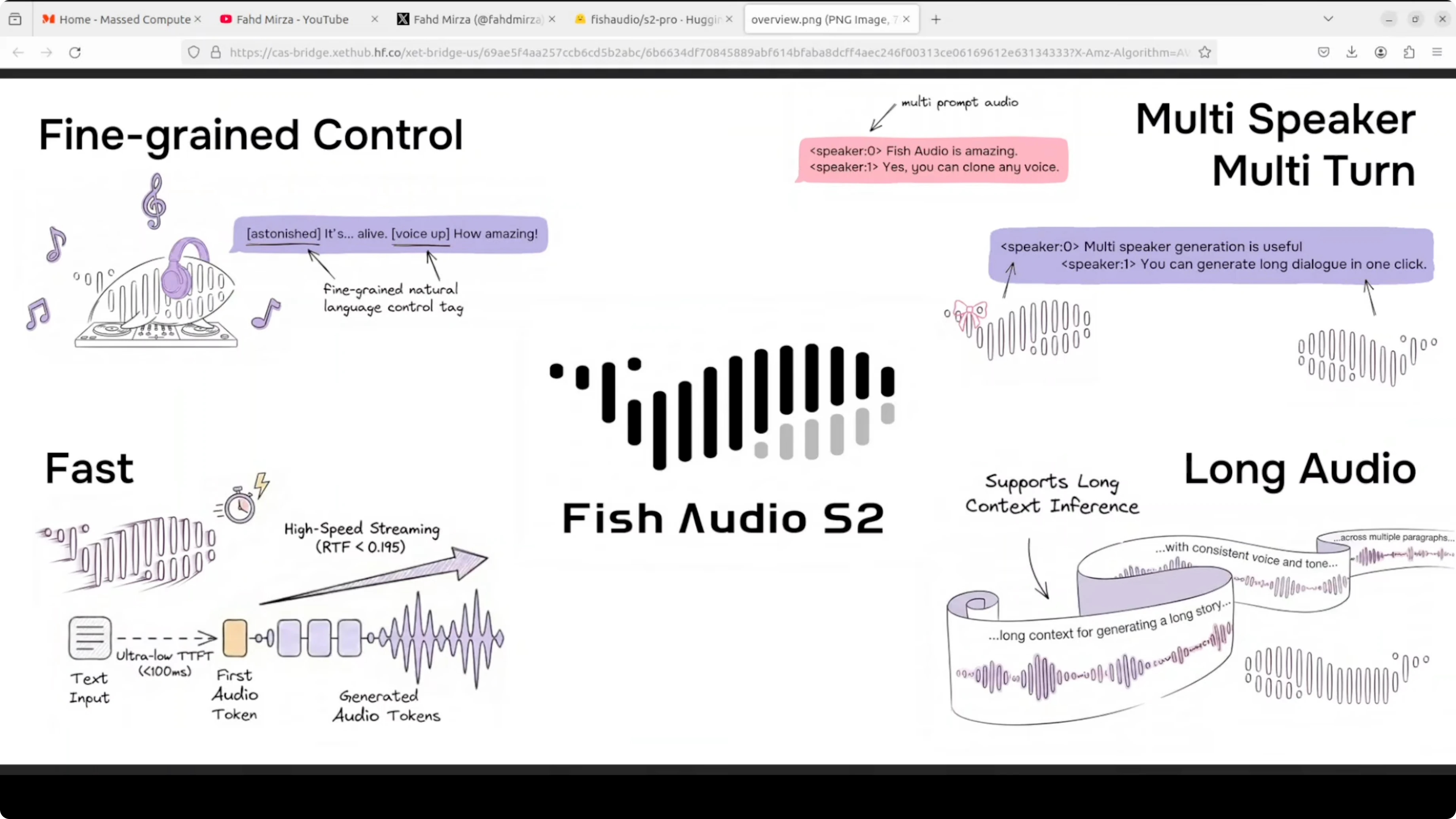
The large model (4 billion parameters) handles timing and meaning - the prosody. The small model (400 million parameters) fills in the acoustic detail.
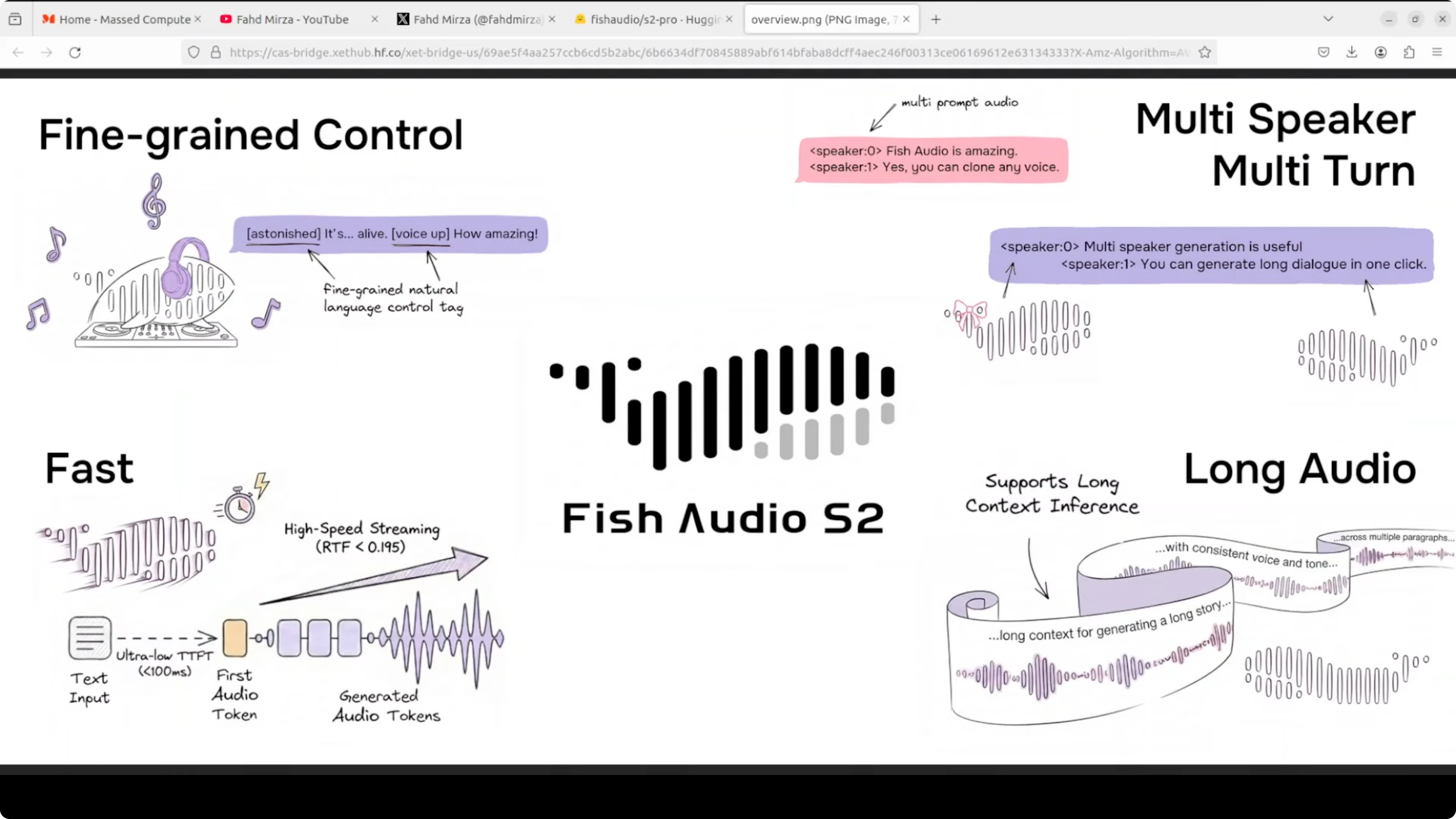
Together they produce high-quality audio fast - around 100 milliseconds to first audio output. The inference engine is built on SGLang, the same serving stack used for LLMs. Production-ready out of the box.
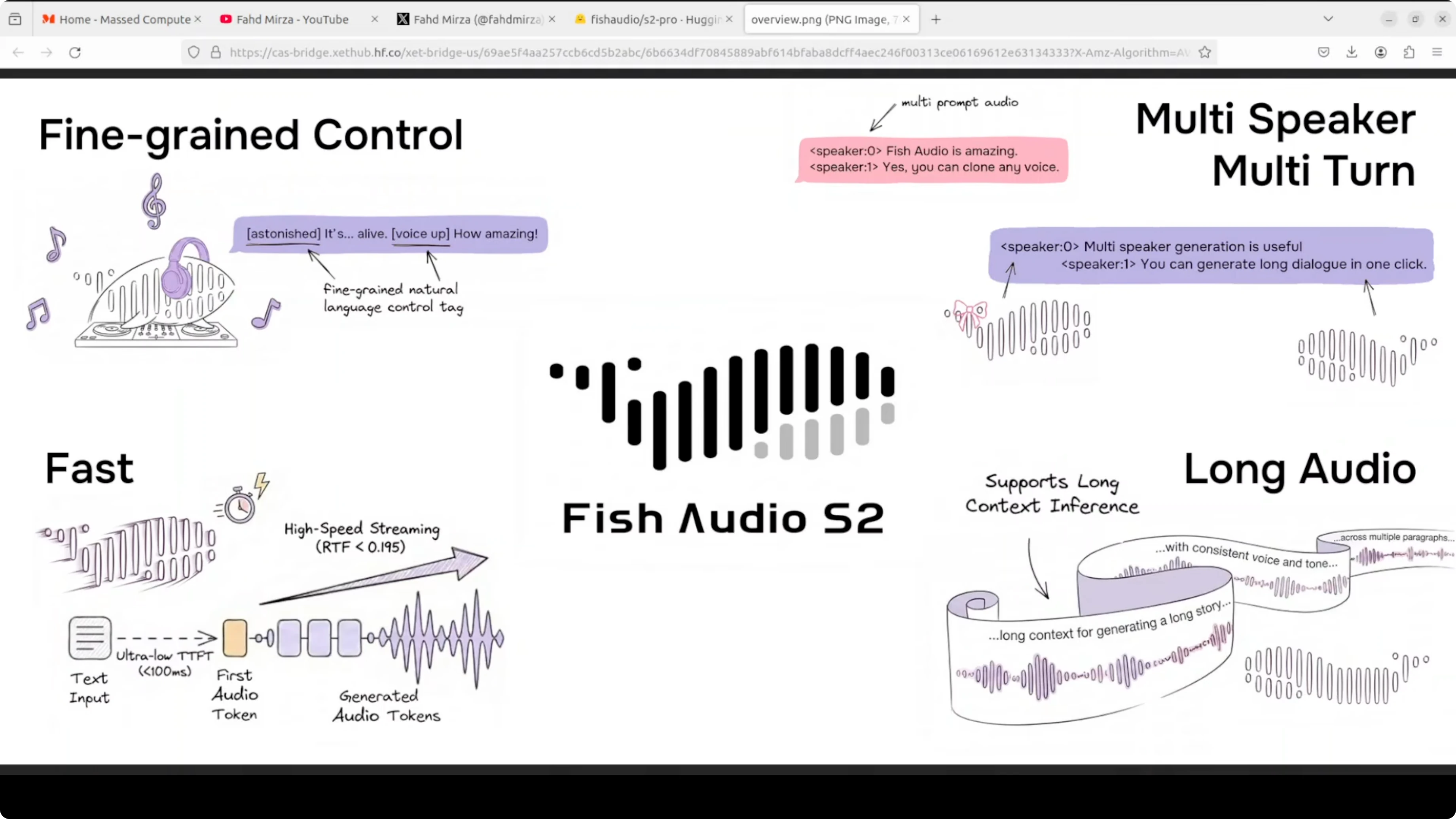
The architecture uses a dual autoregressive (AR) on top of an RVQ audio codec with 10 code books at 21 kHz. If you track LLM stacks, you'll recognize the pattern.
Need help with AI integration?
Get in touch for a consultation on implementing AI tools in your business.
Installing Fish Audio S2 Pro Locally
I tested on an Ubuntu system with one NVIDIA RTX 6000 GPU with 48 GB of VRAM. During inference, VRAM consumption reached close to 17 GB, so plan accordingly.
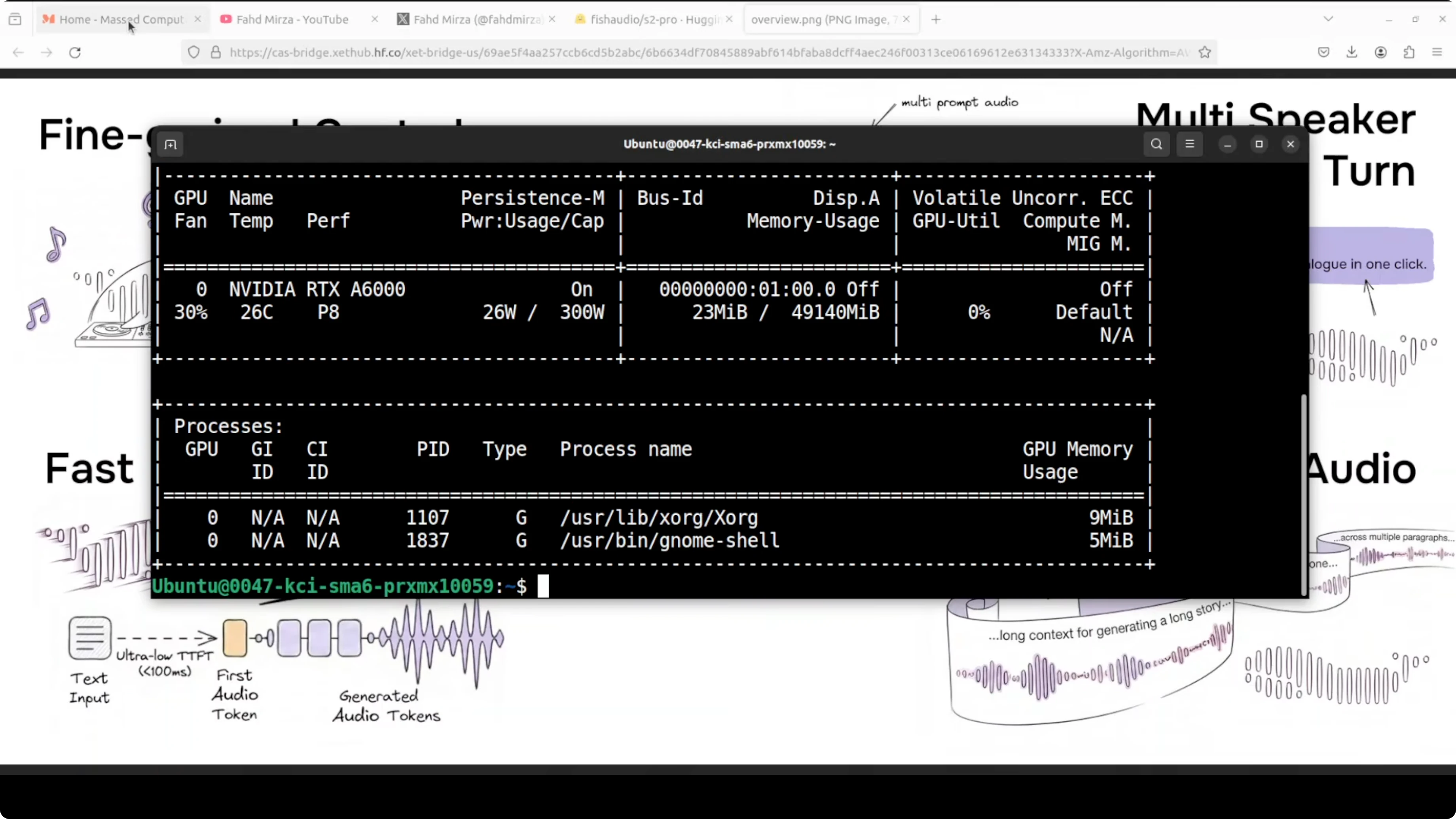
You'll also want recent CUDA drivers and Python 3.10 or later.
System Requirements
Create an isolated environment and install dependencies. This keeps your Python site clean and reproducible:
# System packages you may need
sudo apt-get update
sudo apt-get install -y git git-lfs ffmpeg python3-venv

# Create and activate a virtual environment
python3 -m venv .venv
source .venv/bin/activate
python -m pip install --upgrade pip

# Install PyTorch with CUDA (adjust CUDA version if needed)
pip install torch torchvision torchaudio --index-url https://download.pytorch.org/whl/cu121

# Optional but often required
pip install sglang huggingface_hub soundfile numpy
git lfs install
Get the Repository
Clone the repo that includes the CLI utilities and install its requirements. The project name is fish-speech:
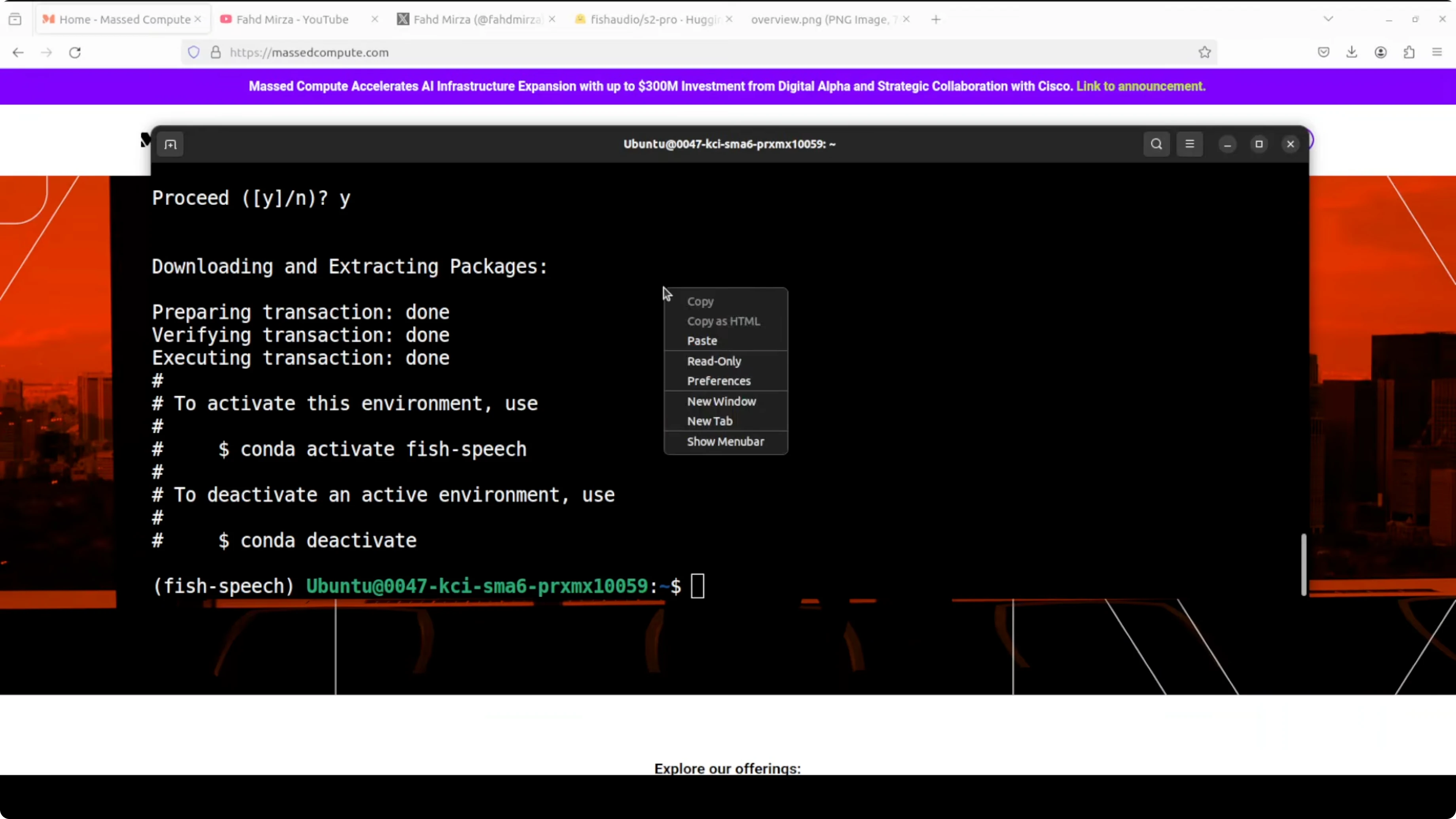
# Clone repo
git clone https://github.com/fishaudio/fish-speech.git
cd fish-speech

# Install Python requirements
pip install -r requirements.txt
Download the Model
You need a Hugging Face token to access the model files. The checkpoint is sharded and around 9 GB total:
# Login to Hugging Face
huggingface-cli login

# Download S2-Pro weights with Git LFS
git lfs install
git clone https://huggingface.co/fishaudio/s2-pro models/s2-pro
License note: The license is not Apache or MIT, so it doesn't seem free for commercial use. Check the licensing for your own use case.
Explore my projects
Check out what I'm working on and the technologies I use.
Voice Cloning with Emotion Control
The web UI isn't working locally in my tests yet. CLI works and follows three clear steps.
Step 1 - Extract a Reference Voice
This step takes a reference audio file and compresses it into an NPY file called ref_voice. Think of it like fingerprinting the voice:
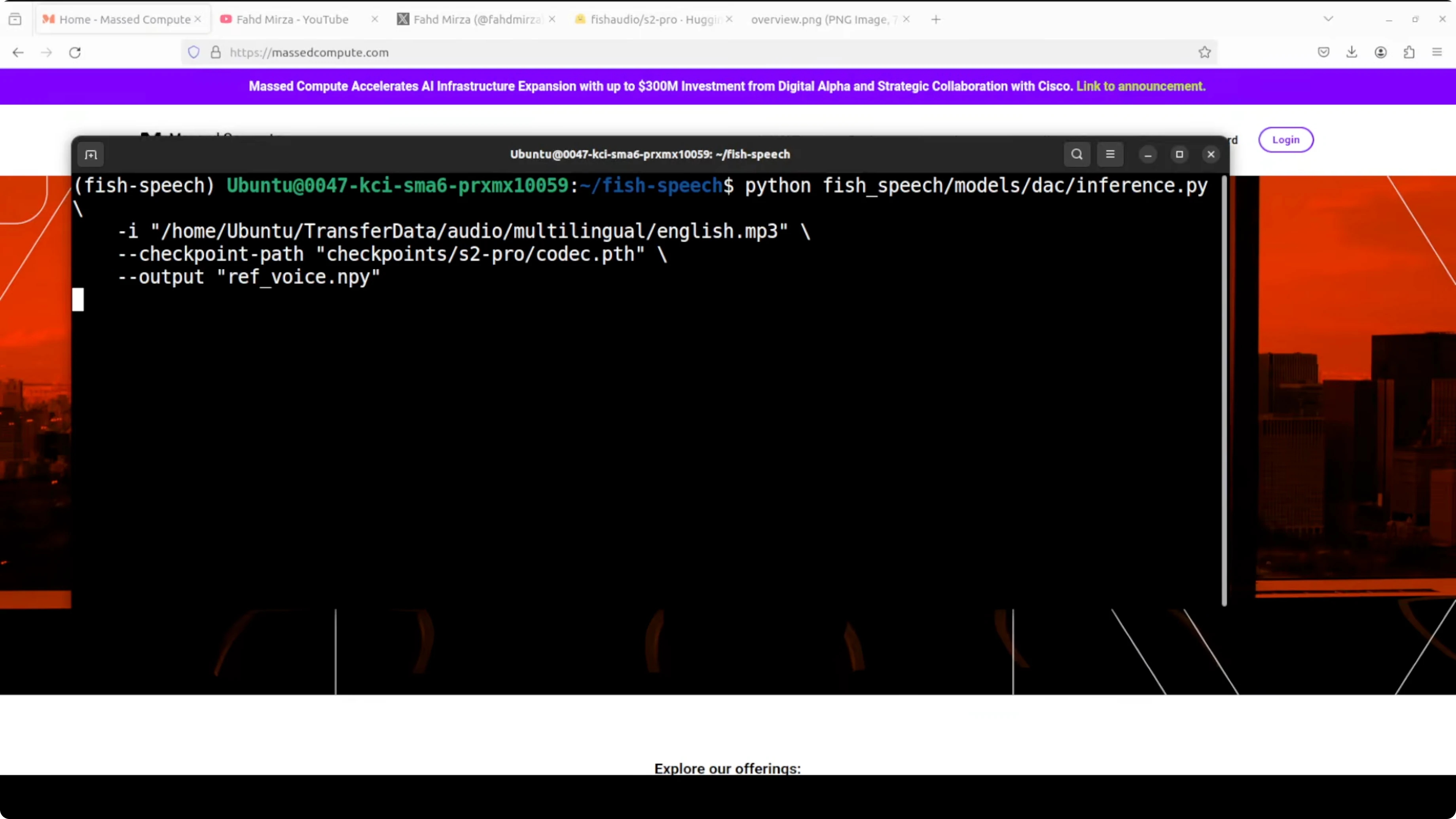
# Example: extract voice tokens from a reference WAV
python tools/tts/encode_reference.py \
  --input data/ref.wav \
  --output workdir/ref_voice.npy \
  --checkpoint_path models/s2-pro
The model breaks the audio down into numbers - tokens that represent the unique characteristics of that voice. The tone, accent, and texture are captured.
Step 2 - Generate Semantic Tokens from Text + Voice
This step takes the input text plus the voice fingerprint and generates semantic tokens. These are not audio yet, just a numerical blueprint of what the speech should sound like:
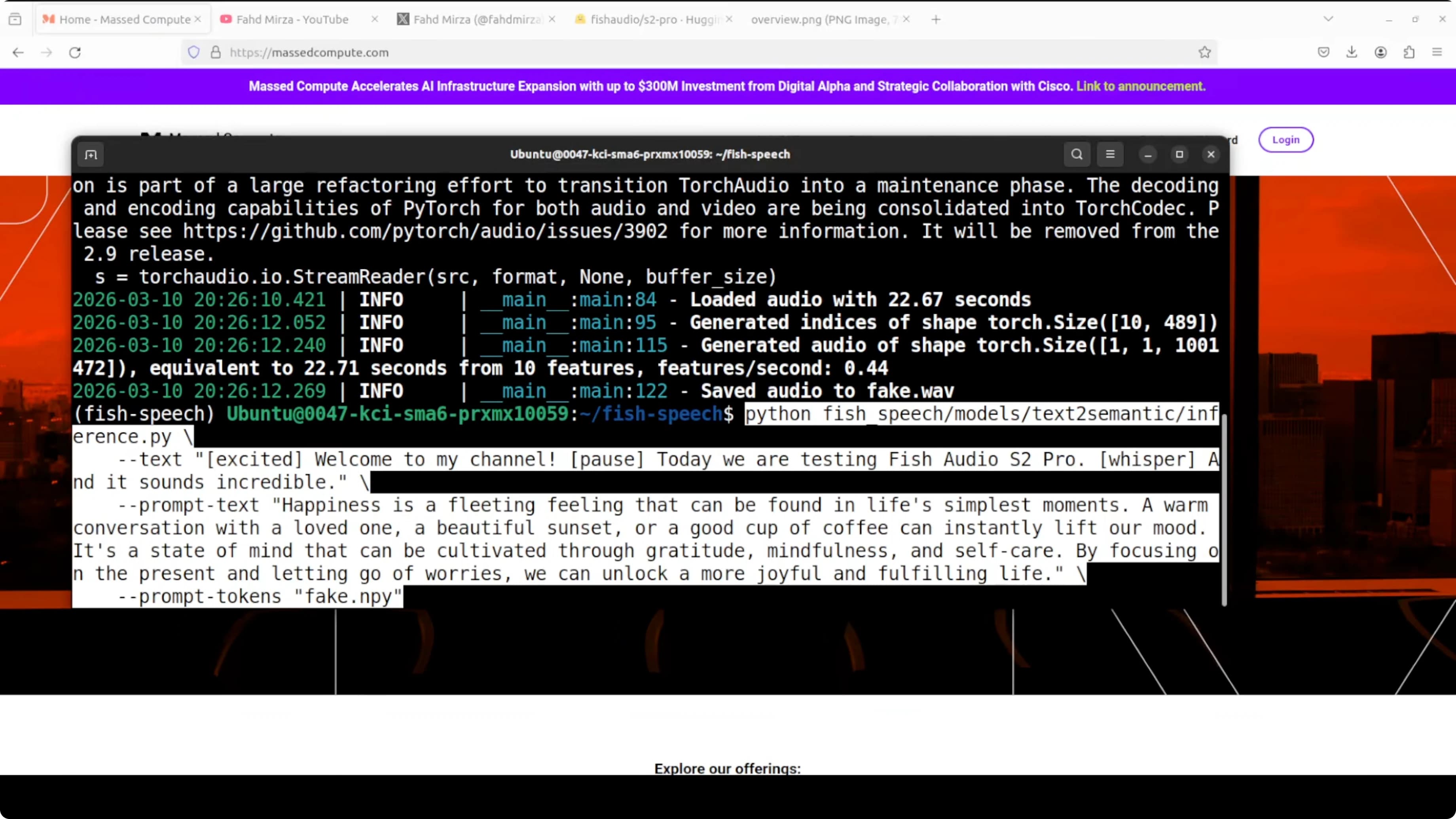
# Example: create semantic tokens
python tools/tts/generate_semantic.py \
  --text "Welcome to my channel. Today we are testing Fish Audio S2 Pro [whisper]." \
  --ref workdir/ref_voice.npy \
  --output workdir/code_0.spk \
  --checkpoint_path models/s2-pro
It's like the model writing sheet music. It knows what words to say, in what emotion, in whose voice, but it hasn't actually sung it yet.
On my setup, generating semantic tokens took around 3 to 4 minutes. Monitor GPU memory with nvidia-smi if you need to keep a cap on VRAM:
# Watch GPU memory
watch -n 1 nvidia-smi
Step 3 - Synthesize Audio from Tokens
Convert the tokens into audio and save a WAV. This is the final rendering stage:
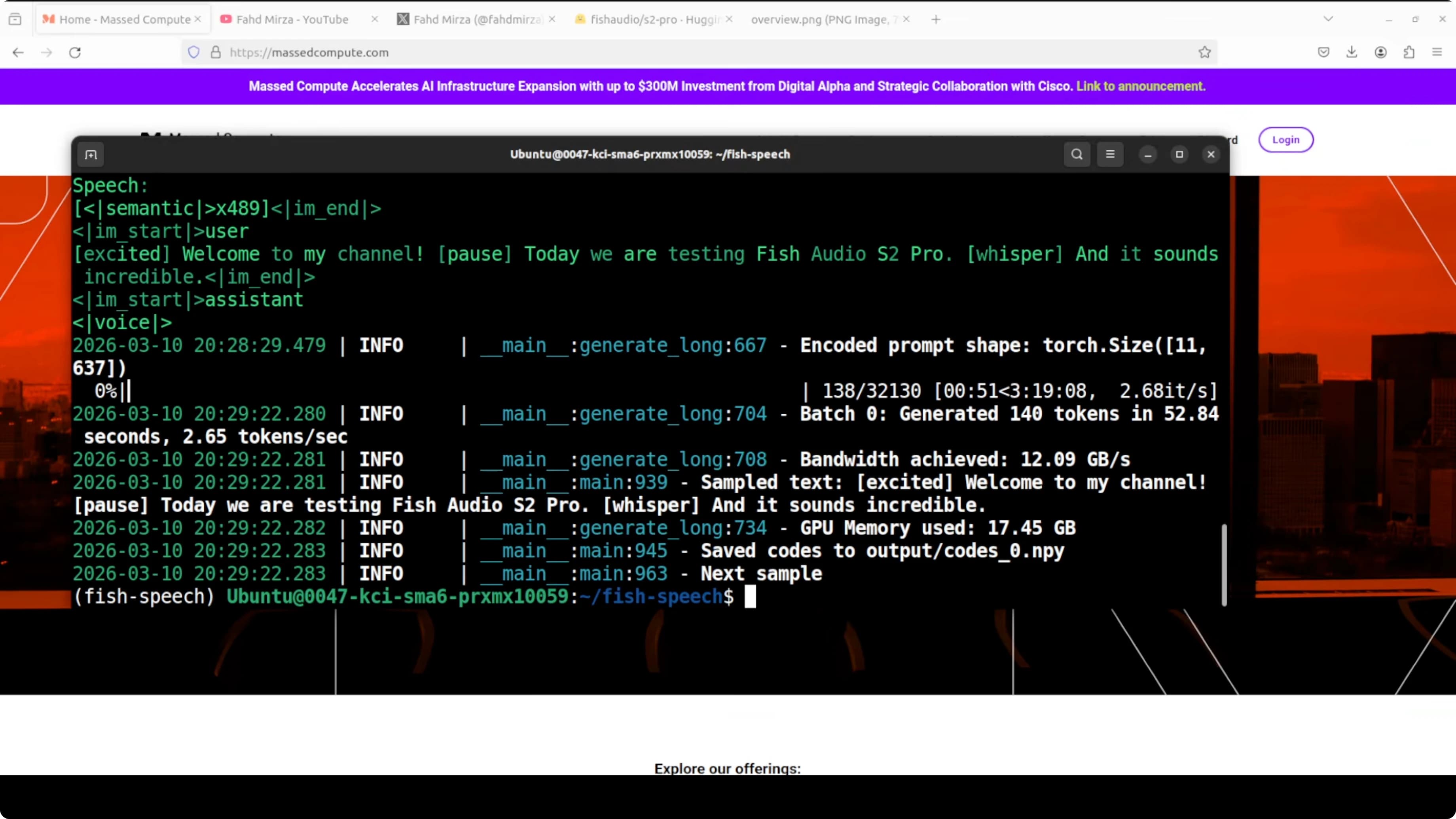
# Example: decode to audio
python tools/tts/decode_audio.py \
  --codes workdir/code_0.spk \
  --output outputs/output.wav \
  --checkpoint_path models/s2-pro
It has saved the file, so you can play the result with your default player. You can script all three steps to run in one go.
Looking for AI consulting?
I help businesses implement practical, scalable AI solutions.
One-Shot Bash Script
I put all steps into a simple bash script so I can swap language and text quickly. Replace the file paths as needed:
#!/usr/bin/env bash
set -euo pipefail

REF_WAV="data/ref.wav"
WORKDIR="workdir"
OUTDIR="outputs"
MODEL_DIR="models/s2-pro"

mkdir -p "$WORKDIR" "$OUTDIR"

# 1) Extract reference voice tokens
python tools/tts/encode_reference.py \
  --input "$REF_WAV" \
  --output "$WORKDIR/ref_voice.npy" \
  --checkpoint_path "$MODEL_DIR"

# 2) Generate semantic tokens for target text
TEXT="$1" # pass the text as the first argument
python tools/tts/generate_semantic.py \
  --text "$TEXT" \
  --ref "$WORKDIR/ref_voice.npy" \
  --output "$WORKDIR/code_0.spk" \
  --checkpoint_path "$MODEL_DIR"

# 3) Decode to waveform
python tools/tts/decode_audio.py \
  --codes "$WORKDIR/code_0.spk" \
  --output "$OUTDIR/out.wav" \
  --checkpoint_path "$MODEL_DIR"

echo "Saved: $OUTDIR/out.wav"
Run it for German or Arabic by changing the input text. You can embed tags like [whisper], [laugh], [excited], or [pause] directly in the text to nudge emotion:
# German example
bash run_tts.sh "Willkommen. Heute testen wir Fish Audio S2 Pro [whisper]."

# Arabic example with expressive hints
bash run_tts.sh "مرحبًا بكم [excited] في هذا الاختبار [pause] اليوم نجرب Fish Audio S2 Pro."
Results and Notes from Experience
On English cloning, I used a line like this: "Welcome to my channel. Today we are testing Fish Audio S2 Pro and it sounds incredible."
This produced a very strong clone of my reference voice. Voice cloning quality is very high.
It takes a long time to generate the audio on my machine. Expressions like laughing or whispering sometimes work and sometimes they are missed, including pauses.
Multilinguality is a bit shaky, especially on the local version. On the hosted version they expose today, I only saw Korean, Chinese, and English. I ran a German prompt and an Arabic prompt as above and got mixed results on expressive tags.
Pros and Cons
Pros:
- Voice cloning quality has improved a lot on this release. It matches the quality tier I expect from the top hosted tools in many cases
- Expressive control is promising with 15,000 tags
- The codebase sits on SGLang, so serving design aligns with modern LLM stacks. That makes it easier to think about scaling and monitoring
Cons:
- Speed is the main drawback on my tests. Generating semantic tokens took minutes and full runs are not instant on a single GPU
- Expressive tags still miss some cues like whisper and laugh in non-English prompts on local runs
- Multilingual support exists across 80 languages in training, but results feel uneven. The hosted endpoints I saw focus on three languages for now
Practical Use Cases
Voice cloning for long-form narration: You can keep tone and texture consistent while adding subtle emotion cues.
Localization workflows: Can benefit from structured tags, once multilingual stability improves. You can drive the same voice across markets with language-specific scripts.
Prototyping assistants and IVR-style systems that need control over prosody and pacing can use semantic tokens to plan delivery. Production teams can wrap these three CLI steps behind a service.
Final Thoughts
Fish Audio S2 Pro brings strong local voice cloning with fine control through text tags. The quality is high, VRAM needs are real, and generation speed plus multilingual stability still need work.
I expect the team to tighten the expressive controls and speed over time. For now, the three-step CLI is the reliable path while the web UI matures.
Useful links:
FAQ
What are the system requirements for Fish Audio S2 Pro in 2026?
You need an NVIDIA GPU with at least 8GB of VRAM to run the model comfortably, or a Mac with M-series chips and 16GB of Unified Memory.
Does it work entirely offline?
Yes! Once downloaded, Fish Audio S2 Pro does not require any internet connection, ensuring complete privacy for your voice cloning tasks.
Can I integrate it with OpenClaw?
Absolutely. Fish Audio S2 Pro integrates seamlessly with local AI frameworks like OpenClaw via their HTTP API servers.